
The Highland Fling, the Triple Crown, and What It Really Means to Finish What You Started

Updated: Sep 4
There’s a moment in every ultra where the world shrinks down to the few feet of trail in front of you. No noise, no drama, no fanfare… just you, your breathing, often a shit tonne of pain, and the stubborn decision to keep moving forward.
The Highland Fling gave me plenty of those moments.
It’s easy to talk about races in terms of splits, checkpoints, and finish times. It’s harder to talk about what they mean. And completing the Highland Fling — and with it, the full West Highland Way Triple Crown — has forced me to sit with that question properly.
This wasn’t just another race. It was the final piece of a 10‑month journey that’s shaped me as a runner and a coach.
The Fling: A Race That Doesn’t Let You Hide
The Highland Fling is deceptive. On paper, it’s 53 miles — and in the shadow of completing the full West Highland Way Race, it’s “only” 53 miles. In fact, if I had a quid for every time someone inferred that it would be easy because of what had already been done, I’d be set for life. In reality, it’s a masterclass in controlled aggression: runnable early miles, a technical mid‑section, and a late dragging section that punishes anyone who’s been too bold. It’s also fifty‑fucking‑three miles.
I went into it knowing exactly what it demands. I’d completed the race last year and, I’ll be honest — it broke me. I was injured on the lead‑up and got through it on pure stubbornness. For that reason, I knew the race required respect, patience, and a willingness to stay uncomfortable for longer than feels reasonable.
Through the combination of my performance last year, uncertainty about how my body would cope on the back of the West Highland Way Race, and an ongoing hip and knee niggle, I took the early start option. If this was a standalone race, I would’ve gone with the mass start. However, it wasn’t. This was the Return of the Jedi race, and I wasn’t taking chances.

The atmosphere at the start of the Fling (WHW and Devil as well) is special. There’s a buzz of excitement but a weird calmness that goes along with it. After a wee laugh at Lyndsay’s supervising and a quick chat with Emily (Emily_intheoutdoors), where I shared the story of my cat getting into my drop bag overnight and stealing my ham and cheese piece… I was away.

From Milngavie to Balmaha, everything felt smooth. The kind of running where you’re not forcing anything; you’re just letting the body do what you’ve trained it to do. I felt strong through Drymen, like I was in full control. On the approach to Conic Hill, I made the decision to kick it up a gear after the leaders in the 6am wave came charging past. Despite the minging steps on the descent of Conic, I managed to get up and down the hill in 36 minutes — 9 minutes faster than I’d ever done it previously. And as a man with the grace of a drunken elephant, I was VERY happy with that.

I arrived at the checkpoint smiling away, seeing a few familiar faces in my coach Kaz (aka the gaffer - Ultrakazy), her husband Scott, and my club mate Alison (scottishmarathongirl). I even had enough energy to run after one of the leaders who dropped his food. A massive shout‑out to Leigh‑Ann Thomson (thetrailgoddess) for sorting my bottles while I scoffed down a rice pudding.
The amazing thing about the Fling is that all of the sections — Drymen, Rowardennan, Inversnaid… each has its own personality, its own challenge. I continued my strong start through Rowardennan and up the high road towards Inversnaid, only to be eaten alive by midges. On the plus side, I think they provided about 2g of protein per breath… evil bastards.
I passed through the Inversnaid checkpoint pretty quickly after a 2‑minute chat with a very active Lyndsay and Ryan (scottishrunner), then moved on to the infamous lochside. This section was brutal in that familiar way: roots, rocks, awkward steps, and the constant negotiation between pace and preservation. But that’s the beauty of the Fling — it strips away ego. And this is also where the wheels came off.

Between the large steps and the micro slips, the niggle in my hip and knee started to play up. This slowed my progress massively — taking 2 hours 20 minutes to cover 7 miles. In the planning for the race, I’d set aside 2:30 for that section, but the strong 35 miles previous had me significantly ahead of my goal time, expecting to finish around 11 hours 30 instead of the 13 hours I predicted. Thankfully, a passing Ian Garnett (ink_and_trails) was able to spare a few paracetamol to help me shuffle through.

I took an extra minute in the Beinglas checkpoint to get myself sorted. I have no idea why, because the midges were awful. A quick bite of a sandwich and I was off again. BTW — the sandwich was awesome… no wonder the cat enjoyed it so much.
The legs felt great, I was ready to get going again, but as soon as I did, I’d get a shooting pain like an electric shock down my thigh, causing my knee to buckle. I tried again… same. And again… same. I was making about 20–30 metres before my knee was coming away from underneath me. At this point the sun was out and it… was… toastie. I frustratingly accepted my fate that the next 12 miles to the end were going to be a long, uncomfortable walk.
Toward Bogle Glen, I got chatting to a few folk and got a wee hug from a passing (and ever‑smiling) Debbie Martin‑Consani as I sat on a rock trying to see if a stretch would help the hip situation. I spent a couple of miles trauma‑bonding with a guy called Barry — absolute gem of a fella. After about 45 minutes of chatting about the usual stuff — where you stay, how you’re feeling, your running experience — we realised that I knew his sister, Lesley. Turns out the ultra scene is a small world full of legends. After a quick chat/moan at Bogle Glen to my pals Charlotte and Fiona, I was off on the last section.
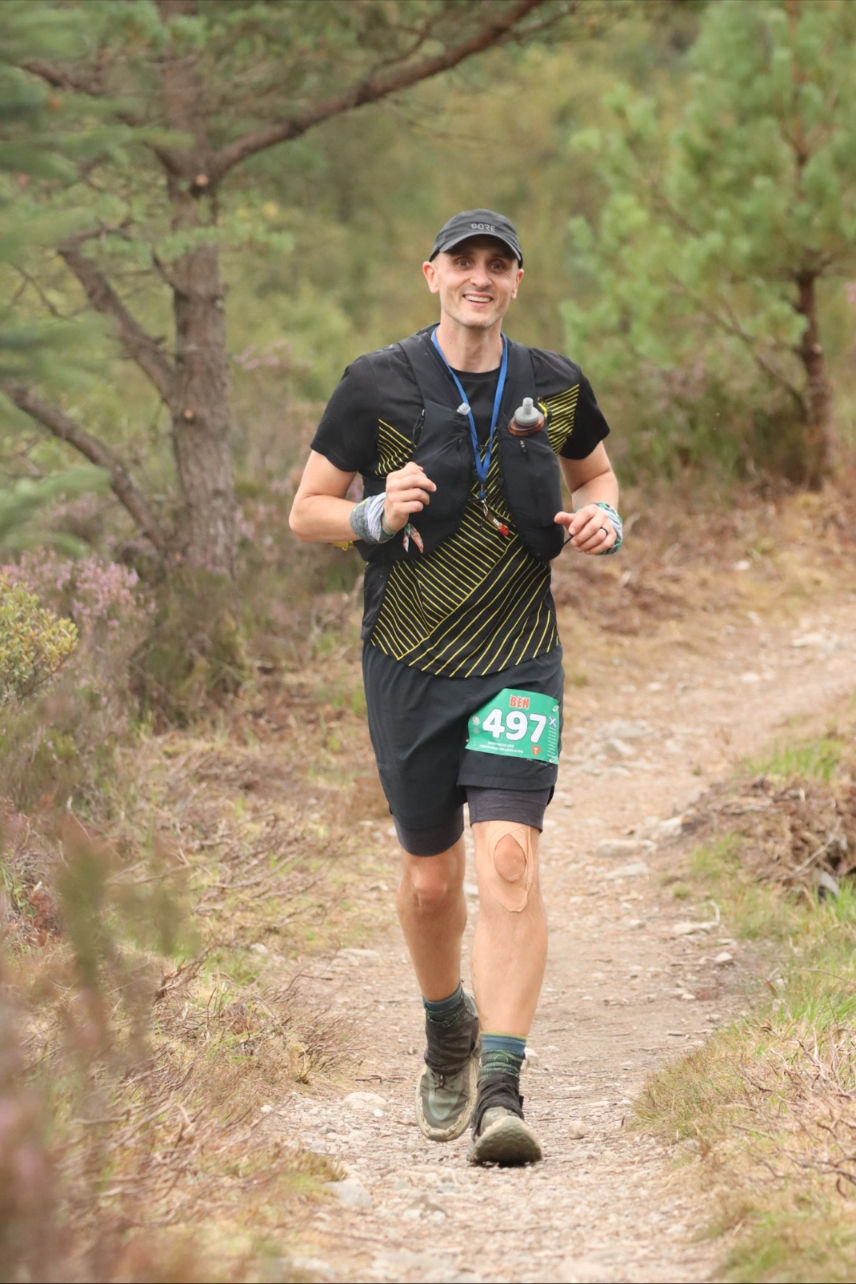
Once you hit Auchtertyre Farm, you know you’re going to hit the end. Even had time for a cheeky wee vomit into a bush. I was feeling fine — just too much liquid in my stomach.
Crossing the Line: More Than a Finish
The finish at Tyndrum is one of the best in Scottish ultra running. The piper, the crowds, the flags, John Cassidy in a multicoloured sequinned suit shouting your name as you run along the red carpet. But it’s also because of what it represents: you’ve earned your place there.

When I crossed that line, it wasn’t all raindrops on roses and whisky on kittens. I was disappointed with my time. I was frustrated that I felt great to press on but my body wouldn’t let me. I analysed my splits and should have been at least 70 minutes faster, if not more. This is something I rarely do. I’m not motivated by times, but I felt the last 12 miles weren't a reflection of the previous 9 months of work which left me a little frustrated.
That feeling lasted a day or so, but when you step back and look at what you’ve achieved, the sense of pride follows. It was the quiet realisation that this was the final chapter of something bigger.
I wouldn’t class myself as a particularly good or gifted runner in the wider sense. This is subjective, of course — and what I mean is that Josh Kerr shouldn’t be worrying about his mile record being taken by me. But in less than 6 years, I’ve gone from a couch‑to‑5k BBC app to a Triple Crown — which fewer than 400 people in the world have completed. If I want people to have a view on me completing the Triple Crown, it’s this: if Ben can do it, then I can do it. This is all from wanting something and going for it.
The Triple Crown: Devil o’ the Highlands, WHW Race, Highland Fling
Three races. Three very different beasts. One shared thread — the West Highland Way.
Completing all three isn’t about medals or titles. It’s about consistency. It’s about showing up day after day, through life changes, weather changes, setbacks, niggles, doubts, and everything else that tries to pull you off course.
The Triple Crown isn’t a trophy (literally). It’s a statement.
A statement that you kept going.
What This Journey Has Taught Me
1. You can’t fake endurance
You can bluff your way through a 10K. Maybe even a marathon, if social media is to be believed. But ultras expose everything — your training, your mindset, your habits, your weaknesses.
2. Community matters more than pace
Every checkpoint, every marshal, every runner you share a few miles with, your crew and the support you get from your family, friends and club mates — they’re part of the story. The WHW community is one of the strongest in the sport, and one I am eternally grateful for.
3. Achievement feels different when it’s earned slowly
The Triple Crown isn’t a weekend challenge. It’s a year‑long commitment. And that makes the finish line feel deeper, heavier, more meaningful.
4. Coaching and running feed each other
Every race teaches me something I bring back to my athletes — pacing discipline, fuelling strategies, emotional regulation, and the art of staying present when things get hard. My experience, good or bad, brings learning.
So What’s Next?
People always ask this. I’m wrapping up the year with a race in October, but that will be me until the spring. For now, I’m letting the Triple Crown settle. Letting the body recover. Letting the mind breathe. And appreciating the fact that sometimes, finishing something is enough.
A quiet winter with more gym work, speedier sessions, and getting the ageing body into the strongest position for the next big ones.
There will be more races. More challenges. More stories. But this one — the Highland Fling and the Triple Crown — will stay with me.
Because it reminded me why I run. And why I’ll keep running.
Finally, a massive well done to everyone who took part in the race. It is easy to normalise these races when you are amongst it but even getting to the starting line with the volume of training required is a fantastic achievement. A massive mention to my club mates - John and Sharon who completed the Fling relay, Neil who bagged another Fling, and Alex , who picked this as her first main ultra (Run the Blades made its way into the training plan as the first actual ultra) and absolutely smashed it. Finally, a massive thank you to Jen, Jean and Richard (the in-laws) and Adam and Scott for coming up to Tyndrum to see me finish this journey... although you missed it... but still even the thought means a lot :).
Anyways, that's enough from me - until next time... TRIPLE CROWN, BAAAEEEEBAYYY!!!


Comments